The Roman Remains at the Great Sphinx of Giza
Appendix 3
Images and Translations of some of the Greco-Roman Inscriptions uncovered at the Great Sphinx
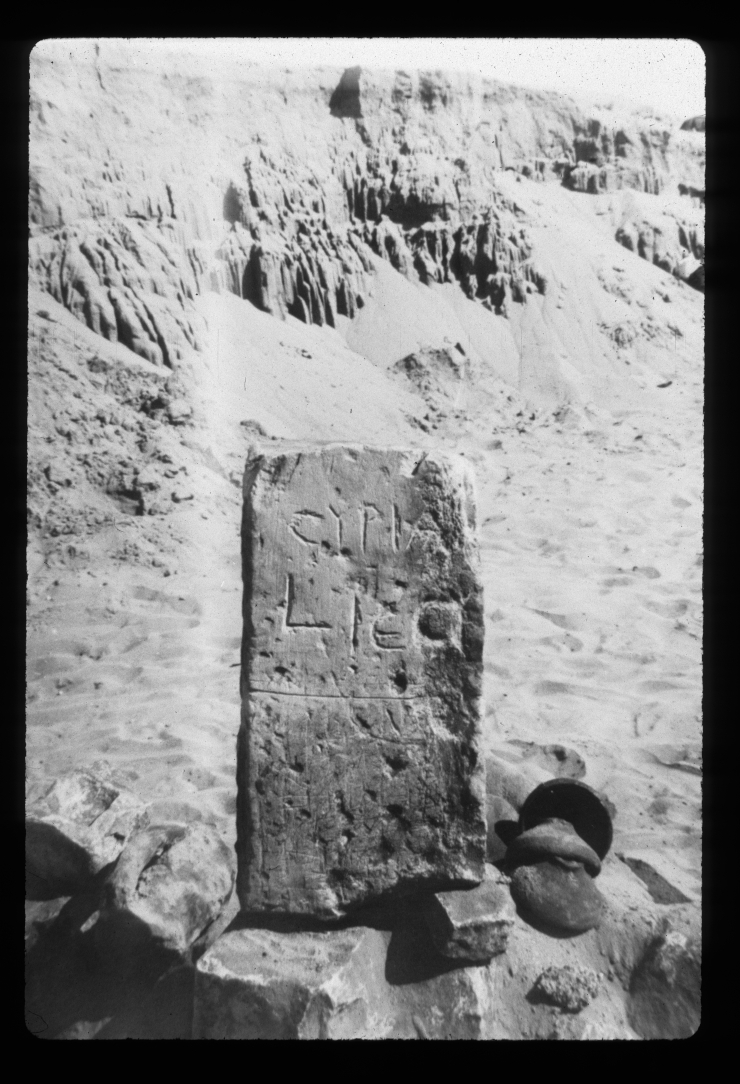
01 · Graffito excavated by Baraize
View full-size plate / photograph · 740 × 1084 pixels
Archives Lacau, Centre Golenischeff, EPHE, PSL; Color Photo 004248 (supplied website JPEG is grayscale). ARCE Sphinx Project 1979–1983 Archive, ed. Mark Lehner, Megan Flowers and Rebekah Miracle; released 23 December 2017.
Source record: https://opencontext.org/media/3f514111-82cb-4af1-85a2-c92da768feb6 · Licence: CC BY 4.0.
Website JPEG supplied by editor; no additional modifications made in preparing this preview.
A slab with a crudely carved Greco-Roman graffito discovered during Baraize’s excavations.
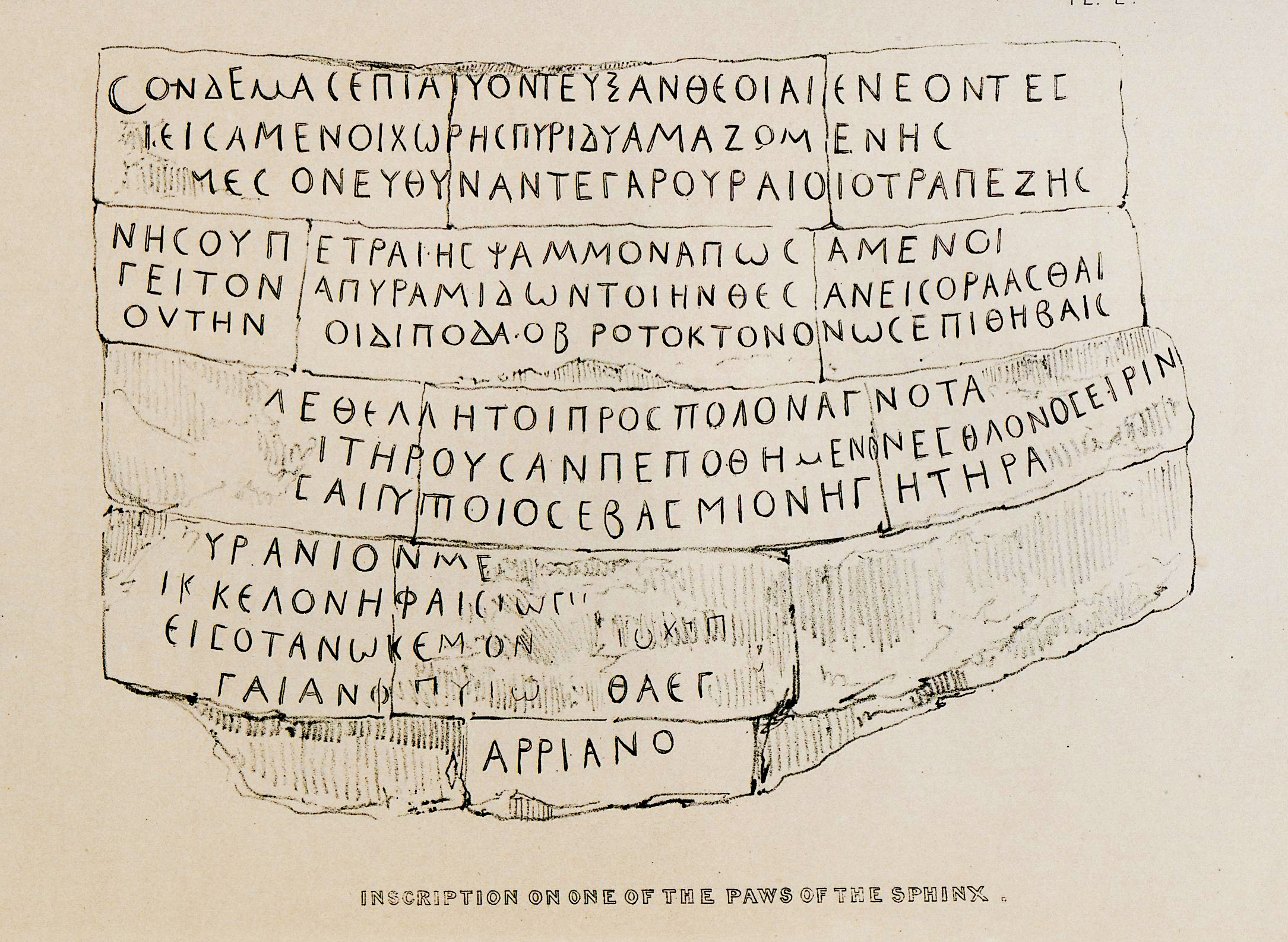
02 · Salutation of Arrian — inscription on the Sphinx’s paw
View full-size plate / photograph · 2169 × 1587 pixels
Richard William Howard Vyse, Operations Carried on at the Pyramids of Gizeh, vol. III (1842); plate E. Digital facsimile: Universitätsbibliothek Heidelberg, page 0194.
A lengthy graffito discovered by Caviglia on the front paw of the Great Sphinx has been translated as follows:
The ever-living gods built thy… form,
Sparing the ground producing corn.
Having raised thee in the midst of the level arable land.
Having driven back the sand from the rocky island ;
A neighbour of the Pyramids they placed thee :
…. such to behold,
Not the slayer of Oedipus, as at Thebes,
But the goddess Latona, a most pure attendant,
….protecting the regretted good Osiris
….the revered governor of Egypt,
….heavenly, great,
…like to Vulcan,
…the earth.
The Salutation of Arrian.
(translation from Operations Carried on at the Pyramids of Gizeh in 1837 With an Account of a Voyage Into Upper Egypt and an Appendix Vol.3 (1842) Richard William Howard Vyse.)
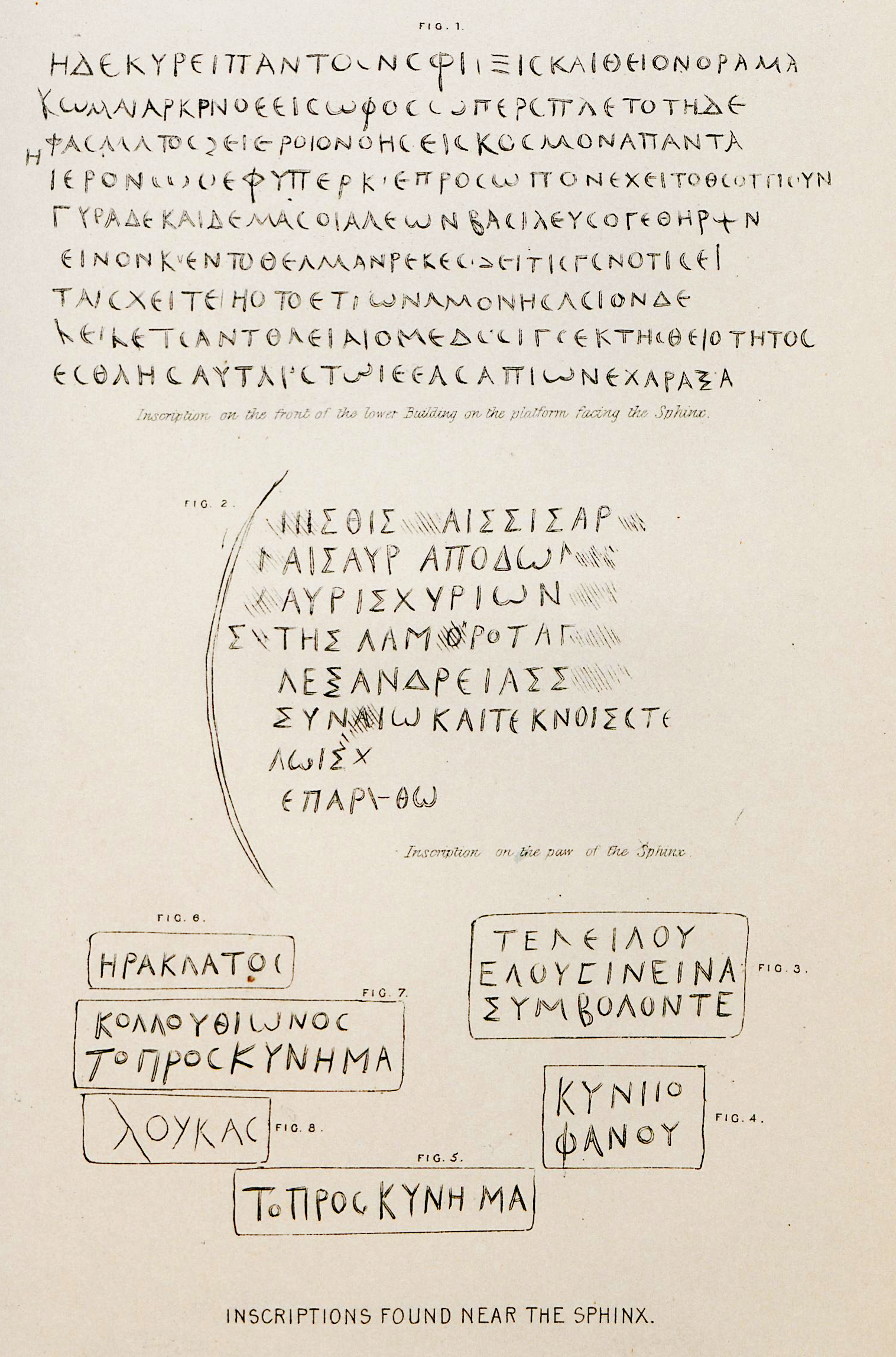
03 · The Sphinx described in Greek — Vyse plate F
View full-size plate / photograph · 1516 × 2296 pixels
Richard William Howard Vyse, Operations Carried on at the Pyramids of Gizeh, vol. III (1842), plate F, figures 1–8. Digital facsimile: Universitätsbibliothek Heidelberg / Operations Carried on at the Pyramids of Gizeh / digital page 0195.
Figure 1 — A Roman visitor’s poem about the Sphinx. The nine-line Greek inscription was copied during Caviglia’s excavations from the front of a structure on the Roman platform. The stone itself appears to have been lost. The English below is our own reading of the surviving nineteenth-century facsimile, checked against the Greek text printed by Étienne Bernand. Parts of the Greek are damaged or editorially reconstructed, especially lines 7 and 8.
This Sphinx has a share in all things — and is a divine sight.
For if you consider its body, and the height it reaches here,
you will perceive the full beauty of a sacred apparition:
above it bears a holy face, breathed upon by a god,
but its limbs and frame are those of a lion, king of beasts.
A fearsome sight! Yet if someone considers it closely …
[…] the name […] Hephaestus […],
[…] from divinity […],
and I, departing from this splendid sight, carved these words.
Jean-Yves Carrez-Maratray restored the first and sixth lines to include “a puzzle to everyone” and “a strange sight”, respectively. An earlier published reading understands the first line differently and the sixth verse as “a terrifying sight”. The lines about Hephaestus remain seriously damaged. This is not a complete, certain translation. Carrez-Maratray also recognised that the first six initial letters of the Greek can be read as Η ΣΦΙΓΞ — “the Sphinx” — if his textual reading is adopted. He proposed that the complete acrostic might have said “This is the Sphinx”; the remaining letters cannot be securely recovered. It is a poem about an enigma, with an enigma built into its writing.
Textual reference: Étienne Bernand, Inscriptions métriques de l’Égypte gréco-romaine no. 130 (Greek transcription); Jean-Yves Carrez-Maratray, “Une énigme du Sphinx: I.Metr. 130,” Zeitschrift für Papyrologie und Epigraphik 95 (1993), 149–152 (study).
Figures 2–8 — Other visitors and acts of reverence. The remaining inscriptions on the plate are fragmentary or very brief. Their readable portions can be rendered as follows:
Fig. 2 · A family visit “… Araissis Ar[…] and Aurelius Apollonios and Aurelius Ischyrion … of the most illustrious Alexandria, with [his] wife and children, Stephanos and Ischyrion … for good fortune.” Heavily incomplete; the family relationships are not certain. (SB 5:8559a.)
Fig. 3 · A damaged fragment “… and of the Nile …” / “… they wish to be …” / “… and a symbol …” These are disconnected remnants, not a continuous sentence. (SB 5:8551a.)
Fig. 4 · A record of devotion “[The act of] devotion of [Ste]phanos.” Parts of the formula and the name are restored. (SB 5:8559b.)
Fig. 5 · An act of reverence “The act of reverence.” Greek τὸ προσκύνημα; no personal name survives on this figure.
Fig. 6 · A visitor’s name “Of Heraklas.” A personal name in the genitive, not the Greek god Heracles. (SB 5:8551b.)
Fig. 7 · The devotion of Kollouthion “The act of reverence of Kollouthion.” An explicit visitor’s act of homage. (SB 5:8557.)
Fig. 8 · Another visitor’s name “Loukas” (Luke). The name alone says nothing certain about the visitor’s faith or purpose. (SB 5:8558.)
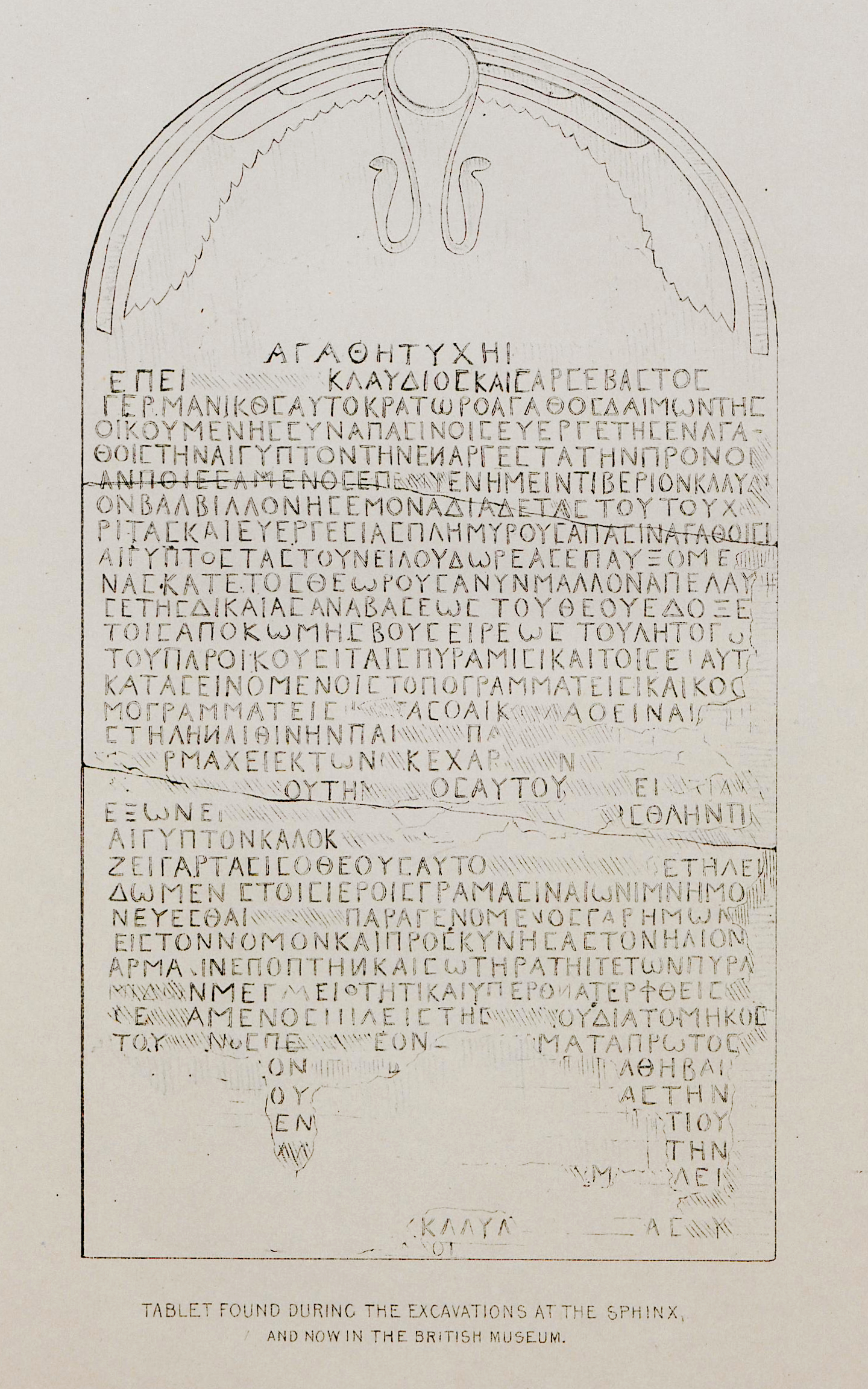
04 · Nero and Balbillus — inscribed tablet
View full-size plate / photograph · 1440 × 2304 pixels
Richard William Howard Vyse, Operations Carried on at the Pyramids of Gizeh, vol. III (1842); plate G. Digital facsimile: Universitätsbibliothek Heidelberg, page 0196.
This stele, from the description available, was probably found on or near the Roman period platform at the top of the Roman stairway. It is particularly important as it mentions the Greek rendering of the Egyptian name of the Great Sphinx – ‘Armachis. The text has been translated as:
To Good Fortune. Whereas the Emperor (Nero) Claudius Ceasar Augustus Germanicus, the good genius of the world, in addition to all the benefits, he has conferred on Egypt, has shown the most especial care of its interests, by sending to us Tiberius Claudius Balbillus as governor, through whose favours and acts of kindness, abounding in all good things, Egypt, be- holding the gifts of the Nile yearly increasing, is now more (than ever) enjoying: the proper rising of the deity, it has seemed good to the inhabitants of the village Busiris, in the Latopolitan Nome, who live near the Pyramids, and to the local and village clerks therein to vote and dedicate a stone column…It preserves his godlike… column ……. in sacred characters to be remembered for ever for having come to our nome, and for having worshipped the sun, Armachis, the overseer, and Saviour, and for having been delighted with the magnificence and…of the Pyramids.
(translation from Operations Carried on at the Pyramids of Gizeh in 1837 With an Account of a Voyage Into Upper Egypt and an Appendix Vol.3 (1842) Richard William Howard Vyse.)
05 · Antoninus and Verus — restoration inscription
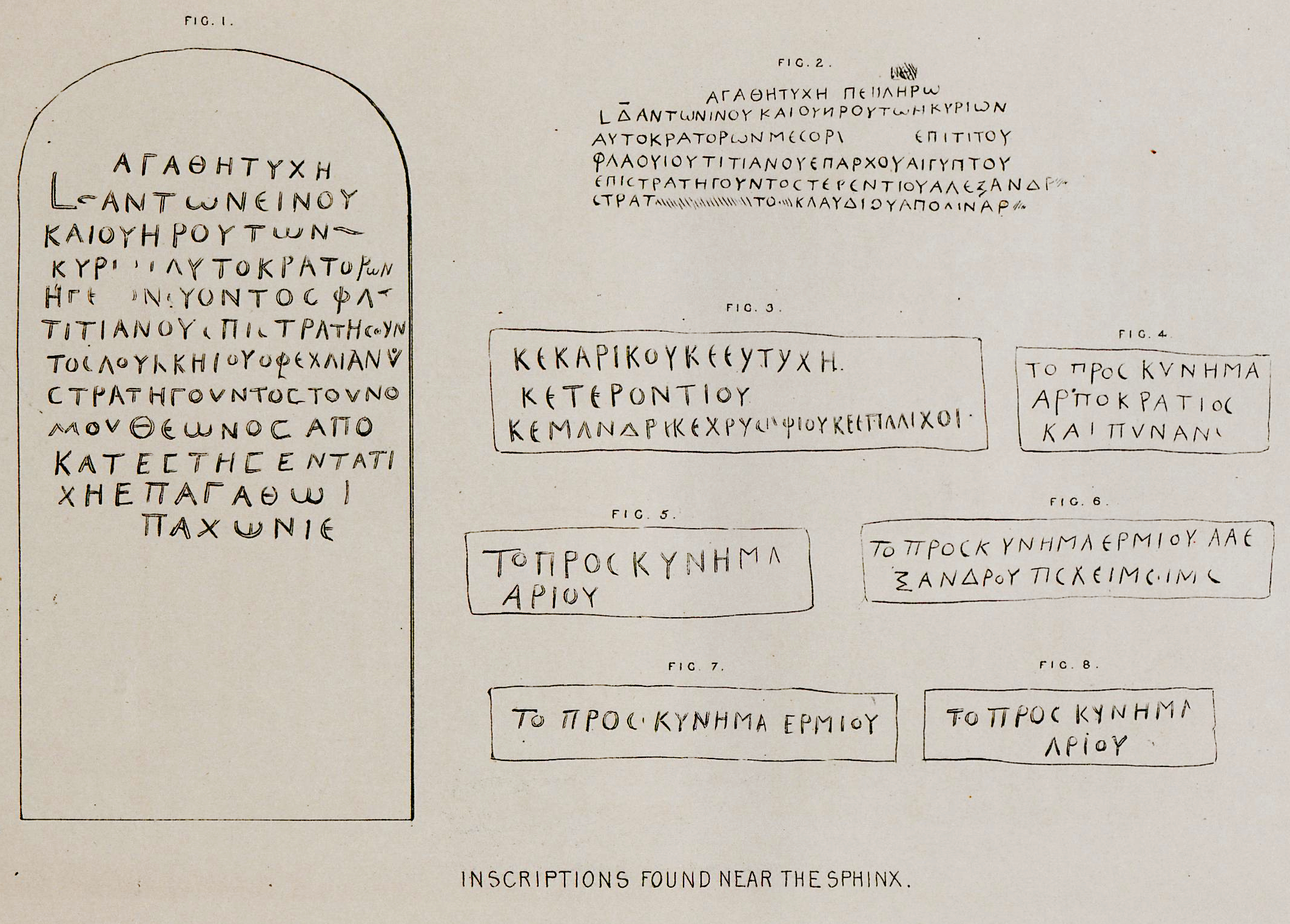
View full-size plate / photograph · 2127 × 1524 pixels
Richard William Howard Vyse, Operations Carried on at the Pyramids of Gizeh, vol. III (1842); plate H (fig. 1). Digital facsimile: Universitätsbibliothek Heidelberg, page 0197.
The larger stele depicted on the left was found close to the pedestal/station depicted by Henry Salt and has been translated as:
To good Fortune. In the sixth year of Antoninus and of Verus, the sovereign Emperors, in the prefecture of Flavius Titianus, Lucianus Ophellianus being Commander in chief, and Theon being the general of the Nome, he rebuilt the walls under happy auspices.
Pachon XV.
(Translation from Operations Carried on at the Pyramids of Gizeh in 1837 With an Account of a Voyage Into Upper Egypt and an Appendix Vol.3 (1842) Richard William Howard Vyse.)
06 · Septimius Severus — inscription on the Roman pedestal
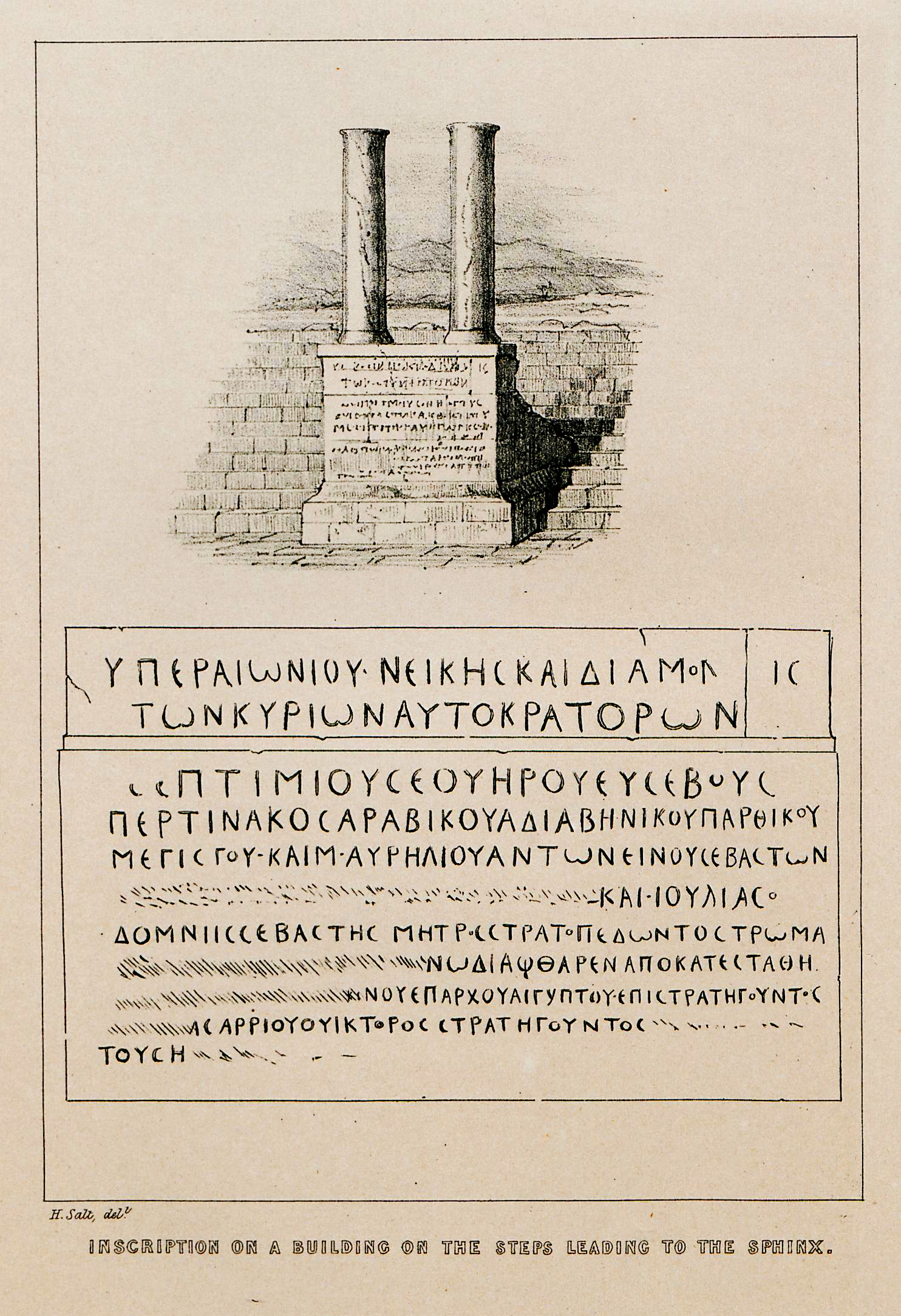
View full-size plate / photograph · 1484 × 2168 pixels
Richard William Howard Vyse, Operations Carried on at the Pyramids of Gizeh, vol. III (1842); plate pedestal plate. Digital facsimile: Universitätsbibliothek Heidelberg, page 0184.
The inscription on the front of the pedestal/station uncovered by Caviglia at the bases of the upper second flight of Roman stairs has been translated:
For the eternal victory, and…of the sovereign lords. Septimius Severus, Pius, Pertinax, Arabicus, Adiabenicus, Parthicus, Maximus, and Marcus Aurelius Antoninus being emperors, …and Julia Domna Empress mother, of the camps, the pavement…having been destroyed, was restored…. nus; prefect of Egypt, being commander-in-chief, Arrius Victor commanding…..
(Translation from Operations Carried on at the Pyramids of Gizeh in 1837 With an Account of a Voyage Into Upper Egypt and an Appendix Vol.3 (1842) Richard William Howard Vyse.)
Further inscriptions and the Sphinx at night — Selim Hassan
In Excavations at Gîza VIII. 1936–1937. The Great Sphinx and its Secrets. Historical Studies in the Light of Recent Excavations. (1953) Selim Hassan recorded 3 further stelae apparently not mentioned in other reports of excavations at the Sphinx:
“The following inscription occurred on a block of limestone discovered by M. Baraize, during his excavations at the Sphinx. It is now in the Cairo Museum:
“Offering of Aragaios, his wife, and their children”.
While another from the same source, reads:
” Adoration of Discoros, the stone-cutter, and his children, and...”
Certain visitors left their inscriptions, either on the Sphinx itself, or on a detached stone placed near it…sometimes they take the form of small poems, in which the visitors attempt to express their admiration. Unfortunately for us, most of those survived are in a fragmentary condition. A poem of this class, which is somewhat well-preserved, was inscribed on a front claw of the left paw of the Sphinx, and is now in Paris. It was published in “Greek and Latin Inscriptions” by Letronne . We possess the entire latter half of another of these poems, which has reached us in a very curious manner. A fragment of it had been in the Vienna Museum for over one hundred years, and was published for the first time in 1829. No one knew from whence it came, beyond the fact that it was purchased in Egypt at the time when Caviglia was making his excavations there in the vicinity of the Sphinx. In 1926, M. Baraize found four more fragments near the Sphinx, and a great Austrian epigraphist discovered that they fitted together with the Vienna fragment. This poem is very interesting, and conjures up, before our eyes, visions of the feasts and gay banquets which used to take place beside the Sphinx, and which sometimes lasted all through the night.
How similar is this to the present day, when every moonlit night brings its party of picnicers to the zone of the Sphinx, when the silence of the desert is once more broken by the sound of laughter and singing, and the youthful lovers wander hand in hand round the Pyramids.
The following is a translation of the part of the poem that has survived:-
...they are perished also,
Those walls of Thebes, which the Muses built;
But the wall that belongs to me has no fear of war;
It knows not either the ravages of war or the sobbing.
It rejoices always in feasts and banquets,
And the choruses of young people, united from all parts.
We hear the flutes, not the trumpet of war,
And the blood that waters the earth is of the sacrificial bulls,
Not from the slashed throats of men.
Our ornaments are the festive clothes, not the arms of war,
And our hands hold not the scimitar,
But the fraternal cup of the banquet;
And all night long, while the sacrifices are burning;
We sing hymns to Harmakhis,
And our heads are decorated with garlands.
This fragment, especially the haunting beauty of the last two lines, is one of those scintillating gems that gleam like stars in the darkness of the Past, and make us regret all the more those treasures which are lost to us for ever.”
Click here to go to Appendix 1 (Images of the Roman Remains at the Great Sphinx of Giza)
Click here to go to Appendix 2 (Images of the New Kingdom and Old Kingdom Remains uncovered by Baraize below the Roman Remains at the Great Sphinx)
To return to the main article click here.
Title Image Details: Archives Lacau, Centre Golenischeff, EPHE, PSL. “Black and White Photo 02377 from Egypt/Giza/Unspecified Sphinx Area 7“. (2017) In ARCE Sphinx Project 1979-1983 Archive. Mark Lehner, Megan Flowers, Rebekah Miracle (Eds.) . Released: 2017-12-23. Licensed under CC by 4.0