Books and articles about the Great Sphinx of Giza
Research on the Great Sphinx is scattered through ancient texts, travellers’ accounts, excavation reports, archaeological surveys, geological studies, conservation literature and modern debates.
This reading room brings together texts that can actually be read online or downloaded in full. Where a work covers a much wider subject, the link is taken as closely as practicable to the page, chapter or article in which the Sphinx is discussed. Where the whole publication concerns the Sphinx, the complete work is linked directly.
Copyright and reuse restrictions
Although many of the older articles and books presented here are in the public domain and free of copyright restrictions, please be sure to verify each source’s copyright status before reusing any of the books or articles linked to on this page.
Broader Giza research libraries
The two collections below range well beyond the Great Sphinx. Both are exceptionally useful starting points for research on Giza more generally, bringing together excavation reports, monographs, articles and archival material. This site also has a short guide to each resource.
Giza Archives Digital Library
A major online Giza research library containing monographs, excavation reports, articles and manuscripts, including many complete searchable PDFs.
Digital Giza Library
Harvard’s Giza Project library, bringing together digitised publications, excavation reports and other research material relating to Giza.
Ancient & medieval accounts Back to top
Book 36, Chapter 17 – The Egyptian Sphinx in The natural history of Pliny (Volume 6) (1855) by Pliny the Elder; Bostock, John, translator; Riley, Henry T, translator
A brief but early discussion of the Great Sphinx dating to the 1st century CE .
Relation de l’Egypte (1810) by Antoine Isaac Sylvestre de Sacy, p179-180
A French translation of Abd Al-Latif’s 1220CE account of Egypt, often used as proof that the nose of the Great Sphinx was still intact in the early 13th century CE
DE LA STATUE NOMMÉE “LE TERRIBLE” in Description topographique et historique de l’Égypte, traduite en français par V. Bouriant. 1re et 2e partie (1886) by Al-Maqrizi and V. Bouriant
French translation of a 15th century text by Al-Maqrizi that recounts details of the defacement of the Great Sphinx
Les saintes pérégrinations de Bernard de Breydenbach , 1483 (1904) by Bernhard von Breydenbach and F Larrivaz. p59
Discusses the great Idol of Isis which is considered to be a reference to the Great Sphinx.
Sixteenth century Back to top
Cosmographie de Levant ( 1556 ) by F. André Thevet, p154-155
Perhaps the earliest European depiction of the Great Sphinx accompanies the text in the style of a Greco-Romano portrait.
Kurtzer und warhafftiger Bericht von der Reiss aus Venedig nach Hierusalem ( 1582 ) by Johannes Helffrich, no page numbers are provided but the section relating to the Great Sphinx, which Helffrich refers to as Imago Isidis , can be found here .
Seventeenth century Back to top
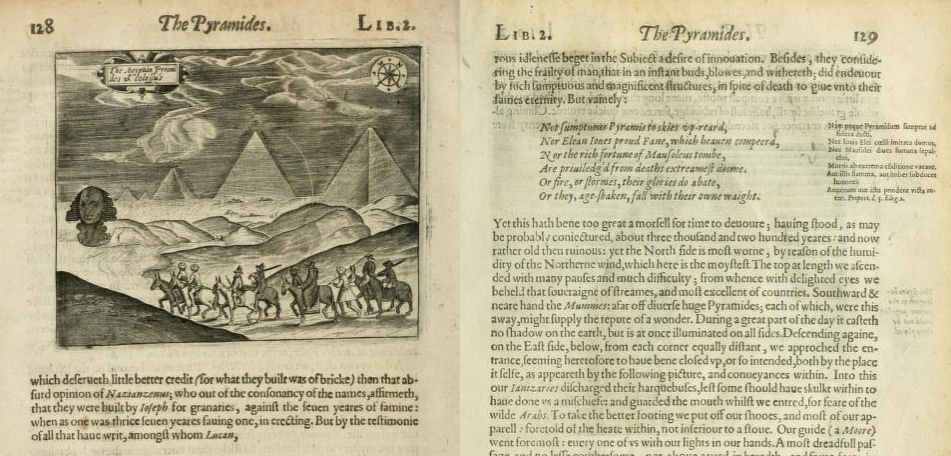
A relation of a journey begun An: Dom: 1610 . (1621) by George Sandys p131-132
There is also a depiction of the Great Sphinx on p128
Les voyages et observations du Sieur de La Boullaye-Le-Gouz, gentil-homme angevin (1653) by François de La Boullaye-Le-Gouz, p361-362
The text has an accompanying caricature of the head of the Sphinx.
Journal des voyages de monsieur de Monconys ( 1665 ) by Balthasar de Monconys p185
The text entions that the nose and chin have been damaged. Also has a crude caricature of the head of the Sphinx.
Of the Sphinx , in The Present state of Egypt, or a New relation of a late voyage into that kingdom performed in the years 1672 and 1673 (English Edition 1678) by F. Vasleb [Wansleben]
Description de l’Afrique ( 1686 ) by Olfert Dapper p65-66
Contains a foldout illustration of the Giza plateau where the Great Sphinx is represented twice: once as a colossal Greco-Romano bust and once as a female Sphinx.
Reizen van Cornelis de Bruyn ( 1698 ) by Cornelis de Bruyn p197-199
Eighteenth century Back to top
A description of the East, and some other countries , ( 1743 ) Pococke, Richard p46
Contains one of the earliest references to the cavity towards the tail end of the Great Sphinx. There is an illustration of the Sphinx’s head on plate 17
Voyage dans la Basse et la Haute Egypte, pendant les campagnes du général Bonaparte Vol. 2 (1802) by Vivant Denon, Appendix p.xi , Appendix p.lv-lvi
Denon’s records from Napoleon’s Egyptian campaign at the end of the 18th century CE. Denon’s depiction of the Great Sphinx, Plate 20 from a series of prints provided separately with Volume 1, can be seen at this link . See also Volume 1, p98
Nineteenth century Back to top
ON EXCAVATIONS BY CAPT. CAVIGLIA, IN 1816 , BEHIND, AND IN THE NEIGHBOURHOOD OF, THE GREAT SPHINX . in The museum of classical antiquities : being a series of essays on ancient art (1860) by Edward Falkener, J.E. Wood, and Benjamin Reed Davies
Art. VIII.- Observations relating to some of the Antiquities of Egypt, from the Papers of the late Mr. Davison. Published in Walpole’s Memoirs. 1817 ., London Quarterly Review (1818) Vol xix
Relating Caviglia’s Excavations at the Great Sphinx including details of many of the Greek inscriptions found.
LE GRAND SPHINX DE MEMPHIS in Recueil des inscriptions grecques et latines de l’Égypte Vol II (1842) by Letronne, Antoine Jean
Details of the Greek and Latin inscriptions uncovered by Caviglia at the Great Sphinx in 1817 .
THE SPHINX. AN ACCOUNT OF M. CAVIGLIA’S EXCAVATIONS IN 1818 TAKEN FROM THE PAPERS OF THE LATE MR. SALT . in Operations Carried on at the Pyramids of Gizeh in 1837 With an Account of a Voyage Into Upper Egypt and an Appendix Vol 3 (1842) by Howard Vyse
Travels along the Mediterranean, and parts adjacent Vol.I ( 1822 ) by Robert Richardson p153-157
Le Sérapéum de Memphis (1882) by Franc̦ois Auguste Ferdinand Mariette, p91-100, Grand Sphinx de Gyzèh .
An appendix (in French) includes a discussion of Mariette’s brief excavations in 1853 at the Great Sphinx including the rear chamber.
Modern Egypt Vol 1 ( 1843 ) by John Gardner Wilkinson
General Discussion of the current understanding of the Great Sphinx in 1843
DENKMÄLER AUS AEGYPTEN UND AETHIOPIEN (1849-1859) by Carl Richard Lepsius
A comprehensive illustrated record of Lespius’s travels through Egypt from 1842-45
1900–1949 — Early modern Sphinx research Back to top
James Henry Breasted. Ancient Records of Egypt, Vol. II: The Eighteenth Dynasty — Dream Stela §§810–815, pp. 320–324.
Dream Stela; Thutmose IV; Horemakhet; primary-text translation.
George A. Reisner. Solving the Riddle of the Sphinx.
Early modern interpretation; Sphinx attribution/history.
George A. Reisner. The Dawn of Civilization in Egypt…The Secret of the Sphinx Revealed.
Early modern interpretation; Sphinx attribution/history.
Uvo Hölscher. Das Grabdenkmal des Königs Chephren — Sphinx/complex discussion begins pp. 15–16.
Khafre complex; architecture; archaeological context.
Alexandre Piankoff. Two Reliefs in the Louvre Representing the Gîzah Sphinx.
New Kingdom chapel; Harmachis; Caviglia finds.
George A. Reisner. The Sphinx Awakens—Again.
Baraize clearance; excavation history; Sphinx interpretation.
Étienne Drioton. Le Sphinx et les Pyramides de Giza.
Sphinx and pyramid complex; interpretation; site approach.
Selim Hassan. The Sphinx: Its History in the Light of Recent Excavations.
Core study; excavation history; cult.
1950–1979 — Excavation, cult and architecture Back to top
Selim Hassan. Excavations at Gîza 8: 1936–1937. The Great Sphinx and its Secrets.
Excavation; Sphinx complex; historical studies.
Siegfried Schott. Le temple du Sphinx à Giza et les deux axes du monde égyptien.
Sphinx Temple; cult; architecture.
Herbert Ricke. Der Harmachistempel des Chefren in Giseh.
Sphinx Temple; architecture; Khafre complex.
Siegfried Schott. Ägyptische Quellen zum Plan des Sphinxtempels.
Sphinx Temple; textual sources; cult and plan.
Rudolf Anthes. Was veranlasste Chefren zum Bau des Tempels vor der Sphinx?.
Sphinx Temple; Khafre; function and cult context.
1980–1999 — Survey, geology and conservation Back to top
Mark Lehner; James P. Allen; K. Lal Gauri. The ARCE Sphinx Project: A Preliminary Report.
Survey; archaeology; geology.
K. Lal Gauri. Deterioration of the Stone of the Great Sphinx.
Conservation; geology; stone deterioration.
K. Lal Gauri. Geologic Study of the Sphinx.
Geology; stratigraphy; weathering.
John A. R. Legon. The Giza Ground Plan and Sphinx.
Site plan; geometry; Sphinx placement and interpretation.
Mark Lehner. Archaeology of an Image: The Great Sphinx of Giza.
Core study; survey; reconstruction.
Feisal A. Esmael (ed.). The First International Symposium on the Great Sphinx: Towards a Global Treatment of the Sphinx.
Survey; geology; conservation; history.
Mark Lehner. Documentation of the Sphinx — pp. 55–107.
Survey; archaeology.
Mark Lehner. Reconstructing the Sphinx.
Survey; reconstruction.
Bent Heick-Hansen. The Sphinx temple.
Sphinx Temple; architecture; attribution.
Zahi Hawass. The Great Sphinx at Giza: Date and Function.
Dating; function; archaeology.
Mark Lehner. Notes and Photographs on the West-Schoch Sphinx Hypothesis.
Geology; dating debate.
Zahi Hawass; Mark Lehner. The Passage Under the Sphinx.
Tunnels; archaeology; restoration.
Zahi Hawass. The Secrets of the Sphinx.
Core study; archaeology; public synthesis.
2000–2009 — New debates and archival recovery Back to top
Salah el-Kholi. The Lost Colossus of the Mate of the Sphinx (Surriat Abu al-Holl).
Second-Sphinx tradition; medieval Arabic sources; reception.
A. J. Shortland; C. J. Doherty. Comments on A Geomorphological Study of the Giza Necropolis, with Implications for the Development of the Site.
Geology; weathering; dating debate; response to Reader.
Colin D. Reader. A Response to Comments on A Geomorphological Study of the Giza Necropolis.
Geomorphology; dating debate.
Toby A. H. Wilkinson. Comment on C. D. Reader, A Geomorphological Study of the Giza Necropolis.
Archaeology; dating debate.
Christiane Zivie-Coche. Sphinx: History of a Monument.
History; cult; archaeology.
Mark Lehner. Unfinished Business: The Great Sphinx — pp. 10–15.
Archaeology; research history.
Mark Lehner. The Sphinx.
Synthesis; archaeology.
Colin D. Reader. The Age of the Sphinx and the Development of the Giza Necropolis.
Sphinx dating; geomorphology; development of Giza necropolis.
Christiane Zivie-Coche. De Sfinx van Giza en de eredienst van Harmachis.
Horemakhet/Harmachis; cult history; New Kingdom and later Sphinx reception.
Frank Preusser; Shin Maekawa; Eric Doehne; Charles Selwitz. The GCI/EAO Environmental Monitoring Program at the Great Sphinx of Giza.
Conservation; environmental monitoring.
Hany Helal. Engineering Stability and Conservation of the Sphinx: Diagnosis and Treatment.
Engineering; stability; conservation.
John P. Gnaedinger. Proposed Hypothesis, Testing and Documentation, and Actions to be Taken for the Conservation of the Sphinx.
Conservation; diagnosis; testing.
Shawky Nakhla; H. Hubacek; M. Abd el-Kader; F. el-Gazzar. Modern Consolidants: An Approach to the Consolidation of the Mother Rock of the Sphinx.
Conservation; stone consolidation.
Shawky Nakhla; M. Abd el-Kader. Mortars and Stones for the Restoration of Masonry Works in the Sphinx.
Restoration; masonry; mortar.
Stéphane Pasquali. Les fouilles de S. Hassan à Gîza en 1938 et le temple d’Osiris de Ro-Sétaou au Nouvel Empire.
New Kingdom Giza; Ro-Setau; Sphinx environs; excavation history.
Stéphane Pasquali. Baraize Excavations 1933–1934 at Giza: What is New with the Chapel of Amenhotep II.
Baraize/Lacau archives; New Kingdom chapel; excavation history.
2010–present — Recent fieldwork and digital survey Back to top
Mark Lehner. Who Built the Sphinx? The Sphinx Temple Has the Answer.
Builder attribution; Sphinx Temple; geology; quarry sequence.
AERA. Return to the Sphinx Viewing Project — pp. 8–9.
Survey; GPR; 3D recording.
Samuel Boury; Scott Weady; Leif Ristroph. Sculpting the Sphinx.
Erosion; yardangs; geomorphology.
Rebecca D. Sperber; Dean Goodman; Mark Lehner; Glen Dash. Where the Water Disappears: A Ground-Penetrating Radar Survey near the Great Sphinx of Giza — pp. 19–23.
GPR; subsurface; Sphinx Temple.
Zahi Hawass; Mark Lehner. The Return to the Sphinx Viewing Project — p. 18.
Recent fieldwork; survey.